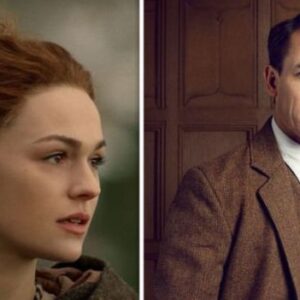
So, Steven Knight has all but confirmed that there will be a series two of House of Guinness – so long as Netflix has the thirst (and with these ratings, Netflix will be thirsty).
But what could it be about? Will Arthur survive Patrick Cochrane’s bullet, or will it miss him by a waxed whisker to hit a family member behind him on stage? Will Rafferty and Lady Olivia make good their plan to love in secret, or will Alfred shoot it down (assuming he isn’t shot down himself)? Will Edward roll over for a life with a woman he doesn’t love, or roll back under the flame-haired Fenian, Ellen Cochrane?
Series one had more unfinished business than a Victorian sex party after a police raid.
So, it’s safe to say, barring calamity, there will be a second season. But what could it be about? Well, the good news is, the story is – as the opening credits tell us – “inspired by true stories”.
And there are lots of those to lean into. Here are a few of the real life storylines that could make perfect fodder for future series’.
Arthur will survive Cochrane’s bullet
I’m going out on a limb here: Arthur will definitely not die. The real Arthur lived on until 1915. The question is, how closely Steven Knight will stick to history? There was an assassination in the Guinness family, but that came much later – in 1944, when Edward’s eldest son, Walter, described as a “real-life Indiana Jones” by family biographer Joe Joyce, was gunned down by Zionist militants in Cairo while serving as the British Minister of State for the Middle East.
As for Arthur, nobody ever actually tried to assassinate him, though there was a threat – a letter calling him an “Orange whelp” (translation: a “Protestant puppy”), that added, “We have a person hired to shoot you… and no mistake so take warnin [sic]in time.”
Unless Knight decides to fold Walter’s story into Arthur’s, the latter will almost certainly live to rule another day (and another series). One of the other family members standing behind him on the stage might not be so lucky. Or perhaps it will be Rafferty. As the only major character who is largely fictitious (as this article explains), he’s the one who’s truly expendable.

Lady Olivia and Rafferty’s affair will surely hot up
One thing we can be sure of: whatever happens between Lady Olivia and Rafferty – it will not destroy her marriage to Arthur. They remained married until his death in 1915, aged 74. Lady Olivia, in fact, is said to have been instrumental in Arthur’s decision to leave the brewery for a life in politics in 1876.
It would seem obvious to any storyteller that this affair should be bled for all it’s worth. “True character is revealed in the choices a human being makes under pressure – the greater the pressure, the deeper the revelation,” wrote the storytelling guru Robert McKee.
In other words, we need that affair to continue for these three characters to evolve.

Continued Brotherly Beef
Arthur may survive the bullet, but the next series could see Edward finally unleash the weapon he’s been quietly forging: total control of the brewery. The fallout from the election crisis hands him the perfect excuse to buy out his elder brother in 1876.
In his unofficial biography of the family, the historian Joe Joyce says that Arthur “agreed to leave the brewery suddenly”. It is not known exactly what caused the rift. One story claims his wife, Lady Olivia, talked him into jumping ship after she was almost hit by a Guinness bottle thrown over a wall by a drinker. In other words, she’d had enough of being married to a mere brewer. She wanted the life she felt was her birthright – in the aristocracy.
The buyout must have felt personal. Arthur and his fiercely aristocratic wife retaliated by hurling themselves into a glittering political and social life in London and Dublin, bankrolled by Arthur’s £680,000 payday. Meanwhile, Edward bided his time, steadily constructing the industrial behemoth he ultimately floated for a jaw-dropping £6 million a decade later.
So, the sibling rivalry could easily turn from a spat over stout into a full-scale war for the soul of the Guinness name.
Disgruntled Tenants and The Lough Mask Murders
Series one briefly touches on the friction between the Guinnesses and their Irish-speaking tenants – most memorably when Anne visits an impoverished village near Ashford Castle in episode two. But this thread is far from finished; the real history is as dramatic as anything else in the Guinness saga.
After leaving the business, Arthur’s staunch Unionism and role as a major landowner dragged him straight into the Land War of the early 1880s – a conflict that, for Arthur and his household, soon became a matter of life and death.
The series could lean into the infamous Lough Mask Murders of 1882, when Arthur’s bailiff and the bailiff’s grandson were ambushed and shot by tenants they had tried to evict for non-payment of rent. A massive search ensued, including the Royal Navy, before the two bodies were found weighted with rocks at the bottom of Lough Mask. A controversial trial followed, ending in the hanging of three of Arthur’s tenants, who always maintained their innocence.
It’s a chilling plot line that would force Arthur, Lady Olive, and their staff to live under a very real shadow of assassination, while still trying to uphold the image of grandeur and control that defined their world.

Home Rule and the Phoenix Park Murders
By the end of the series, the Irish Home Rule issue reaches its climax with Arthur’s attempted murder. But there is far more to this tale. In 1870, it was made official with the establishment of the Home Government Association, calling for an Irish parliament. This defined Ireland’s political climate for the next forty years, culminating in the Irish War of Independence in 1919. As members of the political and business class, Guinnesses had skin in this game.
So plenty more where Patrick and Ellen Cochrane came from. One of the most significant events in this turbulent time was the Phoenix Park Murders of 1882. On May 6, Lord Frederick Cavendish, Chief Secretary for Ireland, and his permanent secretary Thomas Henry Burke were stabbed to death in Dublin’s Phoenix Park by members of the Irish National Invincibles.
The assassination sent shockwaves through Dublin’s (and London’s) political elite, of which Arthur, by then, was firmly a part. The brothers may have even known the dead men.
The Syphilitic Cousin and the Straightjacket
In the mid-1890s, Edward’s partnership with his cousin – and brother-in-law – Claude Guinness imploded spectacularly (The Guinnesses did like to keep things in the family).
By then in his forties, Edward announced plans to step down as chairman of the brewery and named Claude as his successor. But Claude soon began to show signs of serious mental illness – historian Joe Joyce suggests syphilis – and had to be removed from the business. Not long afterwards, he was “taken away, literally, in a straitjacket.”
Though this scandal erupted some twenty years after the close of series one, a time jump could easily fold it in – and what a side-plot it could make.