Renata has been one of the strongest forces in The Walking Dead: Dead City Season 3, but Episode 7 delivered a devastating end to her story.
The episode, titled “Hourglass,” sees Aimee Garcia’s character killed in a shocking confrontation with Mason Dillard, played by Jimmi Simpson. Renata had spent the season pursuing Negan while also working alongside Maggie to build a new future for Manhattan. In the end, however, her attempt to stop the cycle of violence cost her everything.
Speaking about Renata’s final moments and her time on the AMC series, Garcia reflected on the character’s journey, the complicated relationship between Renata and Dillard, and the emotional trauma that shaped her decisions.

Renata’s Final Attempt to Choose a Different Path
In her final confrontation, Renata tries to reason with Negan rather than immediately resorting to violence. She makes it clear that she does not necessarily want him dead and instead urges him to change and “grow up.”
But Dillard sees the situation very differently.
Negan’s former friend remains unwilling to accept the idea that Negan should escape the consequences of his actions, particularly after the deaths of the undead companions Dillard had come to regard as his closest friends. He is equally resistant to Renata’s belief that a new and more hopeful society can emerge after years of post-apocalyptic chaos.
When Renata attempts to take control of the situation, Dillard openly challenges her authority before shooting her in the chest.
For Garcia, the tragedy of the moment is tied to the complicated differences between the two characters.
Why Dillard and Renata Were Destined to Clash

Garcia described Renata and Dillard as opposites who nevertheless created an intriguing balance throughout the season.
Dillard spent much of the apocalypse alone. In order to survive emotionally, he created his own version of companionship by forming attachments to walkers. Renata, by contrast, grew up surrounded by a family that remained largely intact — something increasingly rare in the world of The Walking Dead.
She was surrounded by relatives, laughter, food, music and the love of a large family. That upbringing, Garcia suggested, gave Renata something Dillard never truly had during the apocalypse: the ability to hold on to hope.
Dillard found his own way to cope, but it was rooted in imagination and delusion. He built an isolated world around himself, complete with his own food system, karaoke, beer and other comforts that allowed him to survive emotionally.
Renata does not immediately judge him for that world. Their connection even takes an unexpectedly playful turn during their karaoke moment in Episode 5, adding another layer to a relationship that at times appeared to contain a hint of romantic interest from Dillard’s side.
Garcia does not believe Dillard initially intended to kill Renata. Instead, she sees the tragedy as the result of a chain reaction.
The walkers Dillard cared about had become his closest companions. Much like the relationship between Tom Hanks’ character and the volleyball in Cast Away, Garcia explained, Dillard had emotionally attached himself to them because they were all he had. After Negan killed those walkers, the loss became another factor pushing Dillard toward the violent decision that followed.
Renata Had Been Carrying More Grief Than Anyone Realized
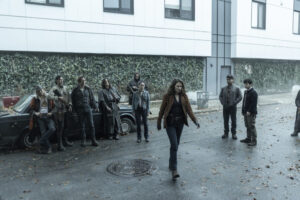
Before her death, Renata has a powerful moment of rage when she stomps on a walker outside the bar.
Garcia believes that moment represented far more than anger over the immediate conflict. It was the release of trauma that Renata had been forced to carry without ever having the time to process it.
She had witnessed the Croat kill both her uncle and her younger brother in front of her. Yet while others had opportunities to grieve and mourn, Renata was repeatedly forced to move forward.
There were immediate responsibilities demanding her attention: saving a baby, ensuring access to a methane tank and helping find a way to rebuild the hospital. Survival and rebuilding took priority, leaving little space for her to confront what she had lost.
According to Garcia, stomping on the walker became a rare moment of emotional release for Renata.
Soon afterward, however, she begins to reconsider her own actions. She realizes that she could have killed Negan at a point when she no longer had the full picture of what had happened with Fabian.
That moment of self-awareness becomes an important part of Renata’s final arc. Garcia said one of the things she admired most about the character was her willingness to take accountability when she recognized that her actions could have led to a terrible outcome for Negan.
What Renata Might Have Done Next
Had Renata survived the confrontation, Garcia believes her character may have taken a step back from leadership.
Rather than allowing pride or ego to guide her, Renata might have handed greater control to Maggie and acknowledged that she was still dealing with the trauma of watching members of her family die in front of her.
Garcia imagined that Renata could have accepted a supporting role, allowing Maggie to take the lead while she continued trying to recover emotionally.
That outlook was consistent with the character’s larger philosophy throughout the season. Renata carried her father’s pendant as a reminder to choose light during the darkest moments, and Garcia believes she genuinely tried to live by that principle.
Her judgment was temporarily clouded by the death of Fabian, who was unarmed when Negan killed him in front of her. The incident triggered painful memories of the Croat killing her uncle and brother under similar circumstances.
Those memories shaped her anger, but they also made Renata’s final choice more meaningful. Even after everything she had endured, she was still trying to imagine a future where people could move beyond endless revenge.
A Farewell to a Character Who Chose Hope
Looking back on her time filming The Walking Dead: Dead City, Garcia said the experience was filled with memorable moments beyond the intensity of the show’s story.
Among her favorite memories were dancing with Lauren Cohan in freezing temperatures, watching Jeffrey Dean Morgan interact warmly with fans, and working alongside Raúl Castillo, Jimmi Simpson and Logan Kim.
She also remembered the cast’s family dinners, often organized by Cohan despite her demanding schedule. Those gatherings gave the group an opportunity to relax, laugh and decompress after filming.
For Garcia, the sense of family behind the scenes echoed one of the most important aspects of Renata herself.
Renata’s life was defined by the strength she drew from family, while her death came at a moment when she was still fighting for the possibility of building a better community. Her story may have ended suddenly in “Hourglass,” but the ideals she represented — accountability, hope and the determination to choose light even after devastating loss — remain central to her legacy.
The Walking Dead: Dead City airs Sundays at 9/8c on AMC and AMC+.
Source: https://www.tvinsider.com/