Netflix’s 2026 adaptation of East of Eden brings John Steinbeck’s sweeping family saga to life with the help of a location thousands of miles from the California setting of the original novel. Rather than recreating the historic Salinas Valley in the United States, the production team turned to New Zealand’s South Island, where preserved Victorian architecture and expansive countryside helped recreate the world of 19th-century America.
The seven-part miniseries stars Florence Pugh and explores the intertwined lives of the Trask and Hamilton families, with particular attention to Cathy’s story. Other cast members include Mike Faist, Christopher Abbott and Ciarán Hinds.
The series offers a different approach from the celebrated 1955 film directed by Elia Kazan. Zoe Kazan, the filmmaker’s granddaughter, serves as writer and producer on the new adaptation. She explained to Netflix’s Tudum that the earlier film covered only a small portion of Steinbeck’s novel, leaving the broader story and its many characters open to further exploration.
But bringing that expansive narrative to the screen presented a geographical challenge. The Salinas Valley has changed considerably since the period depicted in the book, prompting the production to search for locations that could convincingly recreate its historic towns and agricultural landscapes.
Ōamaru: The Victorian Town That Became Salinas

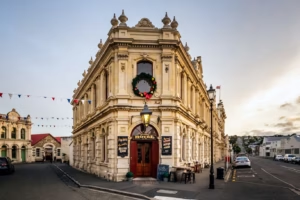
One of the production’s most important locations was Ōamaru, a town in the Waitaki District of New Zealand’s Otago region. Its remarkably preserved Victorian buildings helped transform the South Island destination into the California town where much of the story unfolds.
Zoe Kazan pointed to New Zealand’s Victorian-era gold rush as one reason the country proved particularly suitable for the production. The period brought substantial investment and construction, leaving behind historic architecture that has survived in places where comparable American streetscapes may be harder to find intact.
Ōamaru’s Historic Precinct features late-19th-century limestone buildings, including Smiths Grain Store and The Criterion Hotel, both of which appear in the series. The town’s distinctive whitestone architecture gives its streets an atmosphere that fits the production’s historical setting.
The location has also become a potential destination for viewers hoping to experience the series beyond the screen. The Waitaki tourism board has created an hour-long, self-guided East of Eden walking tour, allowing visitors to explore several places featured in the production.
Among the stops is The Criterion Hotel, which continues to operate as a pub and hotel. Its historic interior retains high ceilings, bars, parlours, a dining room and a Gentleman’s Lounge furnished with leather Chesterfield sofas. Visitors can still eat, drink and stay there.
The walking route also includes The Penguin Club, a live music venue, and the railyard and station operated by the volunteer-run Oamaru Steam and Rail Society, where vintage steam engines help preserve the area’s railway heritage.
Jacob Barwick, property manager for the Oamaru Whitestone Civic Trust, said the production had already generated excitement around the historic precinct. He also anticipated greater interest from visitors as audiences discovered the series.
The walking tour gives fans a chance to explore the town’s historic streets and see the real-world settings that helped establish the atmosphere of Netflix’s adaptation.
Hawkdun Range: The Landscape Behind the Trask Family Farm
Beyond the town itself, New Zealand’s rural scenery was essential to recreating the agricultural world of Steinbeck’s story.
Grant Major, the series’ production designer, told Condé Nast Traveller that scenes set on the Trask family farm were filmed in the foothills of the Hawkdun Range in Otago.
The flat-topped mountain range forms a prominent feature of the Oteake Conservation Park, a remote landscape popular with hikers and mountain bikers. Its broad natural scenery provided a backdrop for the family’s rural life, helping the production evoke the open countryside associated with California’s Salinas Valley.
The landscape offered a different kind of historical authenticity from Ōamaru’s architecture. While the town supplied streets and buildings that could pass for a bygone American community, the Otago countryside helped establish the scale and character of the farmland central to the Trask family story.
Auckland: Victorian Houses and Interior Sets

Auckland also played an important role in bringing East of Eden to the screen. Much of the production’s interior work was completed there, including sets depicting parts of the brothels that feature prominently in the narrative.
Major also highlighted Auckland’s substantial collection of wooden Victorian houses, which gave the production additional options for recreating the period without relying entirely on purpose-built sets.
Together, Auckland’s architecture, Ōamaru’s preserved historic streets and Otago’s rural landscapes allowed the series to construct a convincing version of 19th-century California across several locations in New Zealand.
For viewers interested in visiting the places behind the drama, Ōamaru offers a particularly accessible starting point, thanks to its historic precinct and dedicated walking tour. The series demonstrates how New Zealand’s architectural heritage and natural scenery can stand in for a very different place and period.
Rather than simply reproducing the look of the 1955 film, the new adaptation uses these locations to support a broader exploration of Steinbeck’s multigenerational story, bringing the Trask and Hamilton families—and Cathy’s complex role within their world—back into focus.
Source: Compiled from various sources.