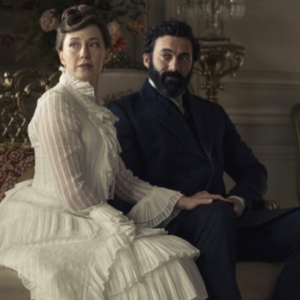
Oscar van Rhijn has always treated marriage like a transaction, but Season 4 rumors suggest his most calculated move yet may become his most dangerous mistake. The carefully orchestrated plan — a so-called “lavender marriage” to Enid Winterton — was designed to stabilize his finances, quiet society gossip, and give him the appearance of security in a world that devours men like him. Now, fan speculation is converging on a far darker possibility: the marriage itself may be the trap.
For viewers, Oscar’s strategy has never been subtle. He needs money. He needs legitimacy. And above all, he needs silence. Enid Winterton appears, on the surface, to be the perfect solution: respectable, socially acceptable, and useful. But The Gilded Age has never rewarded men who believe they can outsmart New York society without paying a price. Season 4 is increasingly being framed by fans as the moment when Oscar’s secret life stops being something he manages — and becomes something others monetize.
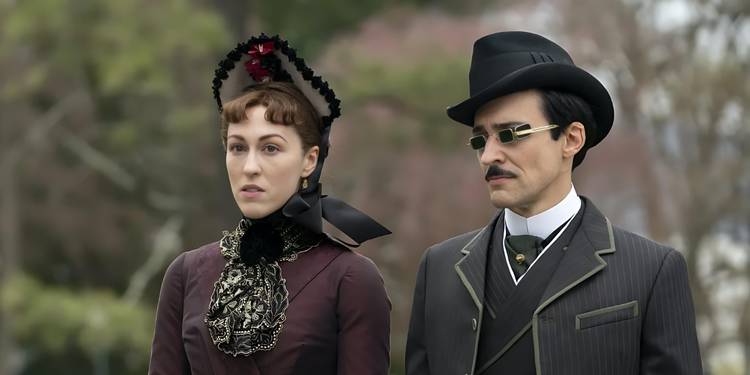
The theory gaining traction centers on blackmail. Someone discovers Oscar’s homosexuality and weaponizes it, not for moral outrage, but for profit. This is the Gilded Age, after all — scandal is currency, and secrets are leverage. The question isn’t if someone finds out. It’s who gets there first.
One popular suspect is Enid herself. Fans point out that her agreement to the marriage feels unusually calculated. Rather than naïve or romantic, Enid is observant, socially alert, and positioned perfectly to notice what Oscar does not say, does not do, and does not desire. If she enters the marriage already aware — or becomes aware quickly — she holds extraordinary power. In this version of the story, Enid does not expose Oscar publicly. She simply drains him quietly, using his fear as a financial pipeline.
Another theory points higher up the social ladder. Mrs. Astor’s name appears repeatedly in fan discussions, not because she needs money, but because she controls access. If Oscar’s secret reaches her, the consequences would be surgical rather than explosive. Invitations disappear. Introductions stop. Doors close. A discreet demand for “assistance” or “donations” would not be framed as blackmail — just the price of remaining invisible.
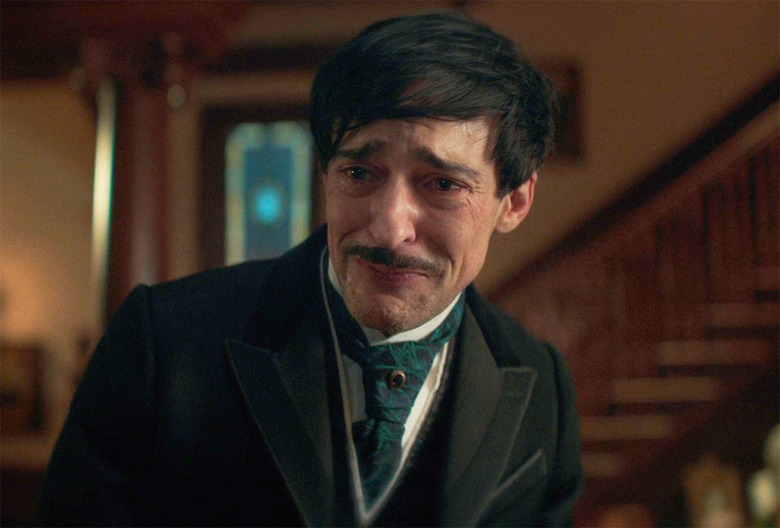
Ward McAllister is another looming figure in this speculative web. As a man who understands society’s underbelly as well as its surface rituals, he would recognize Oscar’s vulnerability instantly. Fans imagine a scenario in which McAllister offers protection in exchange for loyalty, money, or silence — turning Oscar into a permanent asset rather than a free agent.
What makes this theory so compelling is how perfectly it fits Oscar’s established arc. He has always treated risk like a game he can manage. He assumes discretion equals safety. Season 4 may finally prove him wrong. The danger is not exposure in a dramatic courtroom sense, but something far crueler: slow financial suffocation, constant fear, and the knowledge that his marriage is not a shield, but a noose.

If the rumors are correct, Oscar’s wedding will not represent stability. It will represent ownership. Someone will know the truth, and once they do, Oscar’s fortune — already fragile — becomes theirs to control. Every polite smile, every formal dinner, every carefully staged domestic moment will be underscored by the same question: who is really married to whom?
Season 4 has not confirmed any of this, but The Gilded Age thrives on punishment disguised as propriety. Oscar’s secret life has always been one whispered sentence away from ruin. If the blackmail theory proves true, the collapse will not come from scandal headlines or public disgrace — but from the slow realization that the man who tried to buy safety has instead financed his own captivity.
In this version of the story, the wedding is not a beginning. It is the point of no return.