HBO’s The Gilded Age has built its reputation on lush visuals and sharp social commentary, and a recent dinner party scene highlights the show’s strength in quiet, high-stakes drama. Rather than relying on confrontation or spectacle, the moment showcases how a simple exchange of dialogue can reveal layers of history, hierarchy, and unspoken power.

The scene unfolds between Mrs. Winterton and Mr. van Rijn, two characters whose shared past becomes the foundation for an intricate conversation. Early in their dialogue, Mrs. Winterton remarks on the comfort of being seated beside someone who “knows her whole story.” It is a deceptively simple line, but within the rigid world of the Gilded Age, it carries weight. Appearances dictated survival, and secrets often determined status. To admit relief at being known suggests both vulnerability and an acknowledgment that one’s history is too visible to conceal.
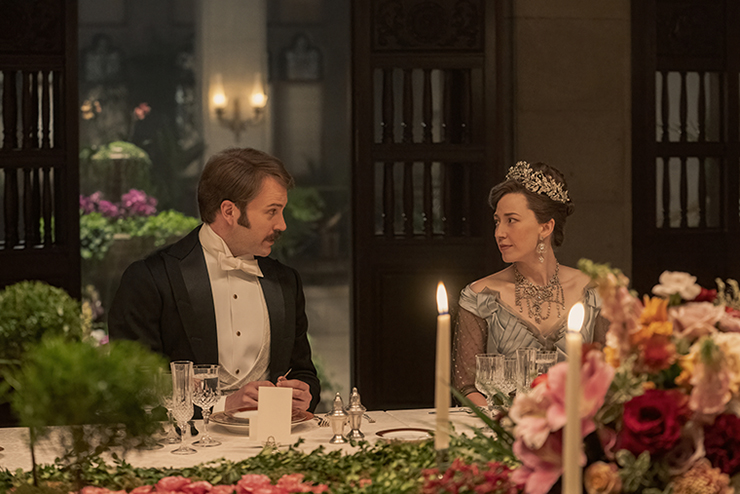
Attention then shifts to Mrs. Winterton’s husband, who is seated with a prominent actress. The choice of seating is not incidental—it underscores the era’s cultural divide. Old money, embodied by families like the van Rijns, often viewed connections with “show business” as gauche, even threatening to the established order. This subtle undercurrent reinforces the persistent tension between traditional elites and the emerging influence of new money, represented by ambitious families such as the Russells.

The conversation also draws upon nostalgia, as the characters recall their years as neighbors. On the surface, it is a gesture of warmth. Beneath it, however, lies a quiet assertion of shared pedigree. In a society where class boundaries were fiercely guarded, these reminders served as a way to reaffirm belonging to an exclusive circle while implicitly excluding others.
The scene culminates in a striking moment of layered subtext. Mr. van Rijn suggests that Mrs. Winterton stay with her former circle instead of with the Wintertons, noting they would be “relieved.” At first glance, it is a gracious offer. On closer inspection, it is a cutting critique masked as kindness—a subtle dismissal of her husband’s social choices and a reminder of where she “truly” fits. It is both a rescue and a rebuke, a maneuver that exemplifies the psychological gamesmanship of the era.

What makes the scene remarkable is its restraint. The drama is not delivered through raised voices or overt conflict, but through carefully chosen words and finely calibrated performances. Every line carries double meaning, every gesture reinforces unspoken judgments.
In many ways, this dinner party encapsulates what The Gilded Age does best: revealing that the greatest battles of the era were waged not on grand stages, but across dining tables, through quiet exchanges laden with consequence. It is storytelling that demands attention to detail, rewarding viewers who read between the lines.